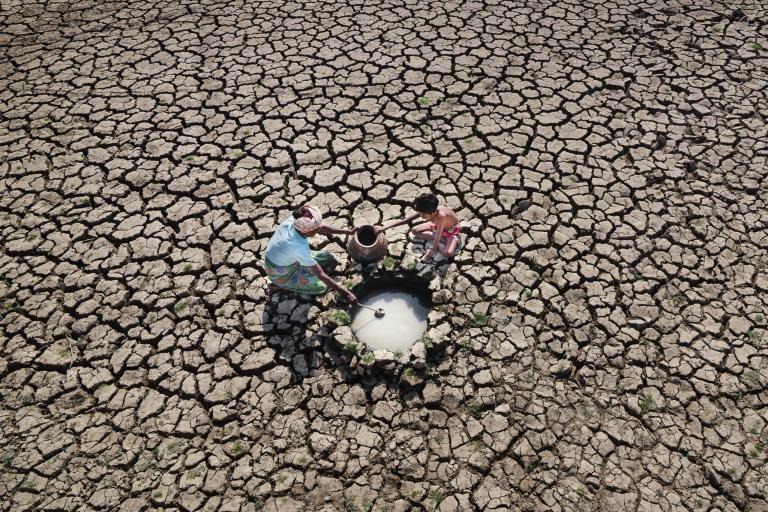
Heatwaves are still not classified as a national disaster in India, and fatalities caused by heat continue to be underestimated. Long-term strategies to reduce heat impacts remain extremely limited, and the few that exist are often poorly directed, experts warn.
Bengaluru: India is currently enduring a heatwave.
On May 17, the India Meteorological Department stated that both daytime and nighttime temperatures were “markedly above normal” – over 5.1° Celsius higher than average – across sections of central and northwestern India including Rajasthan, Madhya Pradesh, Bihar and Gujarat. Temperatures in Delhi are likely to reach 45° Celsius this week. These heatwave conditions – which may also intensify into a severe heatwave in parts of Uttar Pradesh – are expected to persist for nearly a week, it cautioned.
This is the second major heatwave to affect India this summer. Large parts of the country experienced a heatwave during mid- to late-April, and there were also reports of people losing their lives.
But with global warming, that is hardly unexpected, some might say: after all, we are in a “super” El Niño year, and climate change is amplifying the frequency and severity of heatwaves worldwide — including across India.
However, governance shortcomings and inadequate preparedness to manage these escalating heat risks, or reduce them, are worsening the consequences of heat. There are many reasons for this. The Indian government still does not classify a heatwave as a national disaster. Heat-related deaths continue to be severely underreported. Easier and more visible short-term interventions such as setting up cooling shelters receive greater implementation and funding than critical long-term solutions. And those long-term measures that are being carried out – such as tree plantation – are often not focused on the correct populations or locations, and therefore fail to reach communities most vulnerable to extreme heat risks. Yet scientists say there are possible solutions.
A heatwave is described as a period during which local excess heat builds up over a sequence of unusually hot days and nights, according to the World Meteorological Organisation. As per the UN, the world experienced around 4,89,000 heat-related deaths annually between 2000 and 2019, with 45% taking place in Asia.
India declares a heatwave when the maximum temperature at a station reaches at least 40°C or more in the plains, and at least 30°C or more in hilly regions, and when the temperature departure from normal exceeds 4.5°C (or when the actual maximum temperature crosses 45°C).
India is among the nations most severely affected by heat. Due to India’s large population and extensive heatwave-prone area, a 2022 study ranked India’s population and economy as the most exposed to heat risks between 2030 and 2100. According to one estimate, India lost nearly 259 billion labour hours annually due to extreme heat and humidity between 2001 and 2020, a figure translating into an economic loss of approximately Rs 46 lakh crore.
And yet, the union government still does not categorise a heatwave as a national disaster. Consequently, there is a cap on the funding that states and departments can access to implement measures to address heat.
Heat is not classified as a national disaster
At present, states can draw from two mitigation funds – the National Disaster Mitigation Fund and the State Disaster Mitigation Fund – to carry out heat-related actions. But there are also two established response funds meant to address notified national disasters (currently 12, including cold waves) in general: the National Disaster Response Fund and the State Disaster Response Fund. Right now, states may use only up to 10% of their SDRF allocation for disasters they classify as local or state-specific. Funds under the NDRF remain inaccessible to them entirely – because heat is not recognised as a national disaster.
Declaring heatwaves as a disaster would demonstrate that the government is acknowledging the issue, said Abinash Mohanty, head of Climate Change and Sustainability at the advisory organisation IPE Global. Then, he says, financial resources would begin to flow.
According to Tamanna Dalal, a researcher at Sustainable Futures Collective, a Delhi-based independent research institution, the primary reason India should classify heatwaves as a national disaster is because it would create accountability.
“It will establish an accountability framework, a signal that heat is now a national disaster and people at the top are concerned about it. This is currently absent,” she said.
Undercounting deaths, not identifying heat as a cause
But will the Union government agree? It has not done so until now because that would require allocating substantial funds for heat impacts and interventions, including paying Rs 4 lakh as compensation to every individual who dies due to heat-related illnesses, according to Mishra in DTE. But there is ambiguity here as well – because we massively underreport heat-related mortality.
The Ministry of Earth Sciences informed Parliament in August last year that between 2018 and 2022, heat caused 3,798 deaths across India. According to the Indian Express, the National Crime Records Bureau documented 20,615 heatstroke deaths between 2000 and 2020. These numbers suggest that heat causes around 1,000 deaths – or fewer – annually. An analysis of district-level data by scientists at UC Berkeley however indicates that a single day of heatwave across India results in an estimated 3,400 excess deaths nationwide, while a single five-day heatwave leads to approximately 30,000 excess deaths across rural and urban districts combined (based on certain assumptions).
Clearly, India’s heat mortality numbers are a major underestimate. Many scientists have repeatedly raised this concern as well. One reason heat deaths are undercounted is that heat is often not recorded as a cause of death: physicians typically mention only the immediate medical cause on death certificates, without recognising the role of heat as the underlying trigger. According to what Srinath Reddy, founder of the Public Health Foundation of India told the AFP, “incomplete reporting, delayed reporting and misclassification of deaths,” remains a concern.
Not understanding how many deaths occur due to heat means India cannot prioritise measures to confront this disaster.
“For a state like Uttar Pradesh — with 75 districts, over 240 million people, and one of the highest aggregate heat-risk profiles in the country — a 10 per cent access ceiling on an already limited fund is not a safety net; it is a bureaucratic illusion,” wrote Ankit Mishra, a researcher studying environment, climate change, public policy and governance at the Govind Ballabh Pant Social Science Institute in Prayagraj, in a commentary for Down To Earth.
But this could change – if the government acts on the recommendations of the 16th Finance Commission. In its report (released and tabled in Parliament on February 1 this year), the Commission recommended that heatwaves and lightning be added to the list of notified disasters at the national level:
“Although States currently have the flexibility to use 10 per cent of SDRF allocations for State-specific disasters, the increasing severity, frequency, and impact of heat waves and lightning justify their inclusion in the nationally notified list of disasters. Both heatwaves and lightning are severe events that have caused significant loss of life. Given their scale and the fact that they often exceed the coping capacity of affected communities, they merit inclusion in the list of notified disasters at the national level.”
It observed that 11 states have already designated heatwaves as a state-specific disaster, and that many states had “strongly advocated” before the Commission that heatwaves be included among the notified disasters under the national framework as well, due to rising occurrences. The last three Finance Commissions had declined states’ requests to classify heatwaves as a national disaster.
Short-term measures dominate
At present, most of the efforts being undertaken to address heat across the country are short-term ones (such as establishing cooling centres, conducting awareness programmes about heatwaves, or distributing ORS during heatwaves). This is because short-term interventions are more ‘visible’, easier to finance and execute, and because existing government mandates enable more short-term actions than long-term ones, said Dalal.
In March last year, Dalal and her colleagues examined how extreme heat policies are being implemented across nine cities (New Delhi, Ludhiana, Meerut, Faridabad, Gwalior, Kota, Surat, Mumbai and Bengaluru) in India. They interviewed 88 government officials spanning around six departments including health and disaster management.
They found that while all cities reported implementing short-term measures to prevent deaths caused by heatwaves, long-term actions were lacking. This resulted from a combination of several issues, their report said: “weakly institutionalised heat action plans, limited public support for long-term measures, and an interconnected set of institutional constraints”. These constraints included coordination failures and competing priorities among government departments, staff shortages, and insufficient financing.
“Short term actions are important, they save lives,” said Dalal. “But why are they not taking long term actions? Land was one of the biggest issues…people do not want to give land. For example, it is difficult for an urban planning department to convince a developer to maintain setbacks between buildings [mandatory open space required between a building’s outer walls and the property lines or neighbouring structures] on land that could have been used for the building itself.”
There was also “very little imagination” regarding what long term actions would look like, Dalal said; people only understood tree planting. Moreover, their findings reflected what political scientists have observed for several years now – that politicians, voters and implementers all possess “myopic vision”, she added:
“Politicians are here for only five years. They want visible actions that people can vote on.”
Misguided heat actions
The long term measures that are being implemented suffer from a major weakness: they are poorly targeted. Tree plantation is the clearest example of this, said Dalal.
“All departments across India have a greening target which they must achieve every year. Wherever they find land, they plant whatever trees they have without any sort of heat perspective. Are they planting trees in areas with lower green cover? Are they planting trees that have a larger canopy capable of providing more shade?”
Dalal cited the example of a tree plantation drive in Vasant Kunj, a wealthy locality in Delhi, under the Ek Ped Ma Ke Naam scheme last year.
“This is among the richest of the rich areas, considered so green that it is 2 Degrees Celsius cooler than the rest of Delhi. This [planting trees in an area that already has tree cover] is a non-targeted heat action.”
Studies including two recent ones from India demonstrate how important it is to plant specific species of trees, and to plant them strategically – in areas that genuinely require green cover. Scientists at the Indian Institute of Technology Gandhinagar analysed tree cover in 138 Indian cities and found that trees alone are insufficient; cities require smarter and more climate-responsive planning to ensure that tree cover delivers maximum cooling benefits.
“The question is not whether cities should be green. They should be,” said Angana Borah, lead author of the study published in the journal Nature Communications on May 4. “The question is what kind of green, where and how much. In dry cities, vegetation can provide strong cooling benefits. In humid and compact neighbourhoods, planners also need to think about airflow and moisture build-up.”
Meanwhile, scientists at the Indian Institute of Technology Kharagpur combined heat and air pollution indices for Delhi and found that central Delhi – home to substantial green cover due to Central Ridge and other treed areas – was cooler and less polluted compared to other parts of Delhi like Faridabad, Noida and Ghaziabad