The judge declined to step aside in April, and reassigned the case in May. The two actions respond to different legal questions.
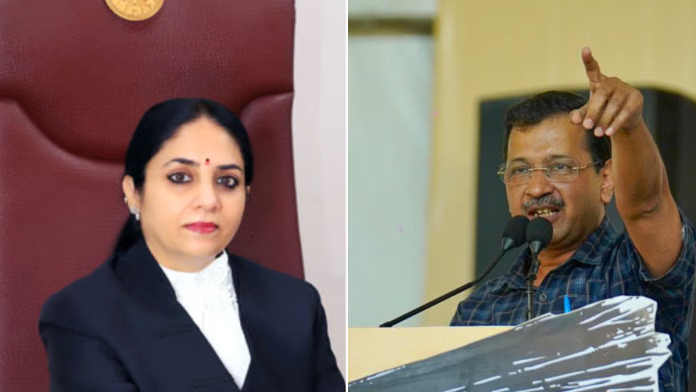
New Delhi: On Thursday (May 14), Delhi high court Justice Swarana Kanta Sharma undertook two steps that seem, at first glance, to conflict. She commenced criminal contempt proceedings against former Delhi chief minister Arvind Kejriwal and five of his Aam Aadmi Party (AAP) associates. Their actions, she observed, amounted to a coordinated social-media offensive directed against her. She then reassigned the excise policy revision petition to another bench. Kejriwal and Manish Sisodia are among the accused in that matter.
Only three weeks earlier, on April 20, the same judge had declined, in a 115-page ruling, to withdraw from the very same case. Kejriwal himself had sought her recusal. What shifted? And how can both rulings coexist coherently?
The explanation is that recusal and contempt address two separate issues. Once that distinction is understood, the apparent contradiction disappears. What remains is a more difficult inquiry: was the course chosen by the judge the sole option available to her?
What is recusal, and why did she decline it in April?
Recusal is a judge’s withdrawal from proceedings because her continued involvement could appear improper. The test, settled by the Supreme Court over decades, is whether a reasonable, informed observer would perceive a genuine likelihood of bias. The benchmark is objective. A judge cannot step aside upon every allegation, because that would hand litigants the power to select benches favourable to them.
Kejriwal, Sisodia, Durgesh Pathak, Vijay Nair, Arun Pillai and Chanpreet Singh Rayat had requested Justice Sharma’s recusal on three grounds. First, they argued that her March 9 order had already recorded a prima facie finding that the trial court’s discharge order was “erroneous”. That observation, they contended, was made after a brief hearing in which the accused were not heard adequately. Second, they pointed out that her children were empanelled as Union government counsel and obtained assignments routed through Solicitor General Tushar Mehta. Mehta appears for the Central Bureau of Investigation (CBI) in the excise matter. Third, they referred to her attendance at four programmes between 2022 and 2025 organised by the Akhil Bharatiya Adhivakta Parishad, the legal affiliate of the Rashtriya Swayamsevak Sangh (RSS).
Justice Sharma rejected all three objections. A prima facie opinion at the stage of a stay application, she held, does not amount to a final conclusion. Her children were among nearly 600 to 700 empanelled lawyers, not specially selected individuals. Her participation in Adhivakta Parishad events, she stated, reflected professional interaction with the bar, not ideological alignment. To recuse on such grounds, she added, would encourage bench-hunting by dissatisfied litigants.
That ruling, in both form and substance, remained firmly within established jurisprudence governing recusal.
What is contempt of court, and what did Thursday’s order accomplish?
Contempt of court is an entirely separate doctrine. The Contempt of Courts Act, 1971 recognises two categories. Civil contempt concerns wilful disobedience of court orders. Criminal contempt, under Section 2(c) of the Act, includes three forms: scandalising the court, prejudicing judicial proceedings, and obstructing the administration of justice. Thursday’s order concerns the first category, scandalising the court.
Justice Sharma held that the conduct outside her courtroom, following her April 20 decision, was not legitimate criticism but a sustained campaign. She then identified the specific allegations she considered contemptuous. The cumulative impact, she concluded, amounted to a coordinated effort that crossed the boundary between criticism and scandalising the judiciary. If such allegations were permitted to spread unchecked, she observed, the consequence would be institutional disorder.
Why does initiating contempt require her to leave the main case, when refusing recusal did not?
This is where the distinction becomes important for the ordinary reader.
A recusal plea asks the court a question concerning the judge: is her continued presence on the bench compatible with the appearance of impartiality? Justice Sharma answered that question in the affirmative in April. The legal threshold, she held, had not been met.
A contempt proceeding asks a different question concerning the litigant: has their conduct outside court crossed from criticism into scandalising the judiciary? The instant a judge concludes that a litigant may have committed contempt, the relationship between judge and litigant changes fundamentally. She now occupies the dual position of adjudicator of their civil dispute and complainant in their criminal contempt. Continuing to hear the substantive matter would transform a procedural separation into an optical impossibility. No reasonable observer would believe her assessment of the merits remained untouched by a simultaneous finding of intimidation.
This is why Justice Sharma remarked in court on Thursday, citing established judicial convention, that “a judge who draws contempt cannot hear the main case”. It was not a reversal of her earlier recusal ruling. It was the application of a distinct principle, triggered by a fact absent in April: namely, her own decision to initiate contempt proceedings.
Solicitor General Tushar Mehta and additional solicitor general S.V. Raju urged her to retain the excise revision while transferring only the contempt matter elsewhere. She declined. Otherwise, she observed, the litigant would retain a continuing grievance whenever she ruled adversely against him.
What follows now?
The CBI’s revision petition challenging the Rouse Avenue court’s February 27 discharge of all 23 accused, including Kejriwal, Sisodia and former Bharat Rashtra Samithi (BRS) leader K. Kavitha, now passes to another judge. The Chief Justice of the Delhi high court will determine the assignment. That bench will hear the agency’s challenge afresh.
The contempt notices, however, remain before Justice Sharma. The respondents will be required to show cause why they should not face punishment for criminal contempt. The Contempt of Courts Act provides for simple imprisonment up to six months, a fine up to two thousand rupees, or both. The judge has additionally indicated that a separate contempt proceeding may arise against YouTubers who circulated an edited clip of Justice Sharma speaking at the University of Varanasi, which she alleges intensified the contemptuous conduct.
But can the same judge hear contempt concerning statements directed at her?
This is the more difficult question, and it sits uneasily within the law.
The foundational rule of natural justice is nemo judex in causa sua: no one should act as judge in her own cause. Justice Sharma is, in one sense, adjudicating her own cause. The contempt concerns allegations against her personally, against her children, and against the bench over which she presides. She occupies, simultaneously, the roles of complainant, witness to the alleged affront, and adjudicator.
The countervailing principle, equally well established, is that contempt of court is not a remedy for a personally injured judge. It exists to preserve public confidence in the administration of justice. The judge serves as a vehicle for that institutional protection, not its beneficiary. On this reasoning, the Supreme Court has for decades heard contempt proceedings concerning attacks on itself. In C.K. Daphtary v. O.P. Gupta (1971), the contempt was heard by a bench from which the criticised judge had already retired. In Prashant Bhushan (2020), a three-judge bench adjudicated contempt concerning tweets critical of the sitting Chief Justice.
Practice, therefore, appears to support Justice Sharma. Principle, however, less clearly so. Senior members of the bar, including the late Fali Nariman and retired Justice Markandey Katju, have argued for a stricter approach. Where the allegation is personal, they contend, the judge most directly affected should withdraw and permit another judge to decide the matter. Their argument is not that contempt of the judiciary cannot be heard judicially. It is that the judge personally targeted is poorly positioned to determine where fair criticism ends and scandalising begins.
Justice Sharma’s position is that she has chosen to treat the affront as one against the institution rather than herself personally. Yet she also recorded that her children were dragged into the controversy, that the campaign constituted deliberate humiliation, and that videos were edited with intent. These are observations characteristic of a witness, not findings drawn solely from an objective record. They place her, when hearing the contempt matter, in precisely the position the doctrine of bias seeks to avoid.
Two procedural alternatives remain available. The Chief Justice of the Delhi high court may, administratively, assign the contempt matter to another bench. Alternatively, Justice Sharma may herself constitute, or recommend constituting, a division bench to hear it. Neither option would weaken the contempt jurisdiction. Both would answer the harder question that naturally arises for an ordinary reader: can the judge who was scandalised reliably adjudicate the alleged scandalising?
The question that remains
The two-track reasoning concerning the main case is internally coherent. The contempt track is less straightforward.
In April, Justice Sharma characterised the recusal request as an effort to place the judiciary itself on trial. On Thursday, she described the contempt proceedings as the consequence litigants would face for the campaign that followed. Both rulings defend the institution. Yet the practical outcome is that Kejriwal will not be heard on merits by the judge whose disqualification he sought. He obtains, through the indirect route of contempt, the bench he could not secure directly through recusal. He also faces a criminal contempt notice for that effort, to be heard before the very judge against whom the alleged contempt was directed.
Whether the social-media material crosses the line from fair criticism into scandalising the judiciary is now for the contempt proceedings to determine. The Supreme Court has repeatedly insisted, from Brahma Prakash Sharma v. State of UP to In re Prashant Bhushan, that the boundary must be drawn with free speech and public confidence firmly in view. Justice Sharma’s recusal ruling spoke of constitutional courage. The contempt jurisdiction will demand constitutional restraint. It will also demand a quieter reckoning with who, precisely, should exercise it.